English Interview Tips for Non-Native Speakers
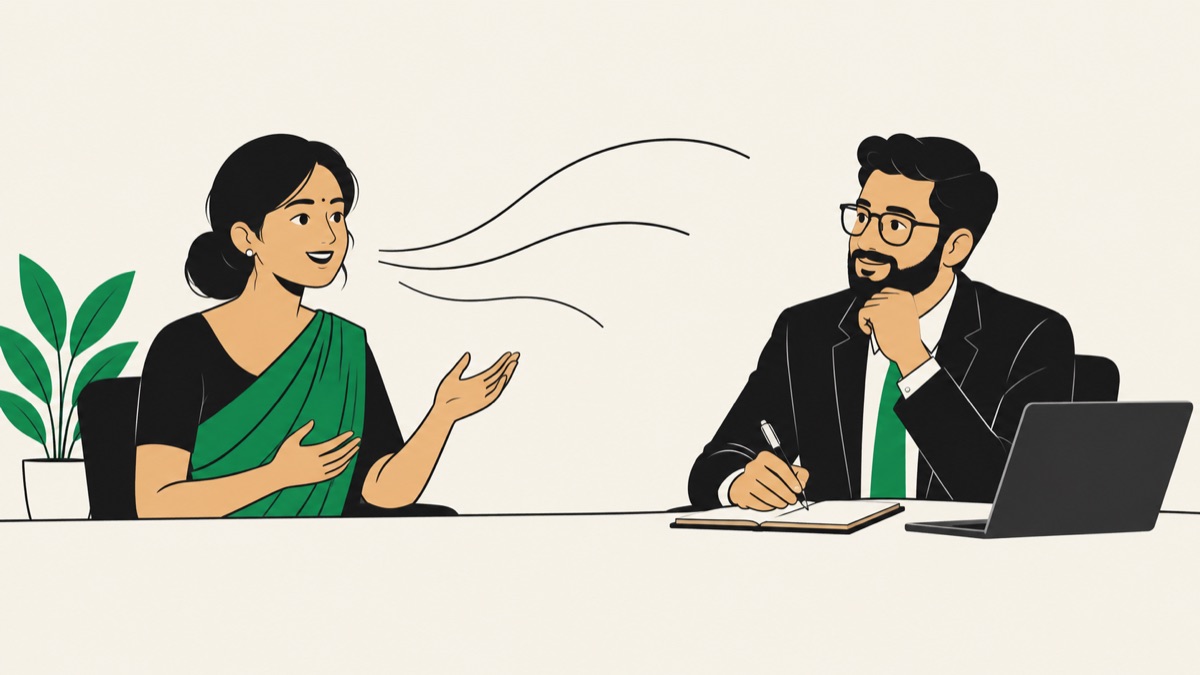
A lot of capable people lose interviews not because they don't know the answer, but because they can't say it the way they want to in English. You know the concept in your head. Then the words come out slowly, you lose your sentence halfway through, and the interviewer's face tells you it isn't going well.
This is extremely common in India, where many people study in English but think and talk in Hindi, Tamil, Telugu, Marathi, Bengali or another language at home. The good news is that interview English is a small, specific skill. You don't need perfect grammar or a particular accent. You need to be clear.
Quick answer: To speak English confidently in an interview, prepare and practise out loud your answers to the ten most common questions, use short sentences, learn a few phrases that buy you thinking time, and slow down. Interviewers care about clarity, not accent or perfect grammar.
What interviewers actually judge
For most roles, interviewers are listening for:
- Can I understand this person easily?
- Do they understand my question?
- Can they explain their work clearly?
They are rarely judging accent, and most aren't counting grammar mistakes. Customer-facing roles and international client roles pay more attention to fluency, but clarity still matters most.
Use short sentences
Long sentences are where non-native speakers get lost. You start with one idea, add a clause, add another, and forget where the sentence was going.
Instead of:
In my previous company where I was working for two years as a developer in the team that was handling the payments which was very critical, I was responsible for...
Try:
I worked at my previous company for two years. I was a developer on the payments team. I was responsible for...
Short sentences sound confident, not simple.
Phrases that buy you thinking time
Instead of silence or "umm", use a phrase that sounds natural while your brain catches up:
- "That's a good question. Let me think for a second."
- "Just to make sure I understand, are you asking about...?"
- "Let me give you an example."
- "There are two parts to this. First..."
- "Could you repeat the last part, please?"
Asking to repeat or clarify is normal. Native speakers do it all the time.
Phrases for common interview moments
Starting an answer: "In my current role, I..." / "The way I usually approach this is..."
Giving an example: "For example, last year I..." / "A good example of this is when..."
Talking about results: "As a result, we..." / "This helped the team to..."
When you don't know: "I haven't worked with that directly, but I've used something similar, which is..."
Ending an answer: "So that's how I handled it." / "I hope that answers your question."
Prepare your top ten answers word by word
For the questions you know are coming, you can prepare nearly the whole answer. Start with these:
- Tell me about yourself. (See our guide on answering "tell me about yourself".)
- Why do you want to join us?
- Walk me through your last project.
- What are your strengths and weaknesses?
- Why are you leaving your current job?
- Tell me about a challenge you faced.
- Where do you see yourself in five years?
- Why should we hire you?
- What are your salary expectations?
- Do you have any questions for us?
Write each answer in simple English. Read it aloud until you can say it without looking. Don't aim to recite it word for word in the interview, but by then the sentences will come naturally.
A 15-minute daily routine
- 5 minutes: read one article in English aloud. Tech blogs, news, or anything related to your field.
- 5 minutes: answer one interview question aloud and record it on your phone.
- 5 minutes: listen back and note one thing to improve: speed, a word you kept repeating, a sentence that got too long.
Do this for two weeks and you will hear the difference.
Slow down
Nervous speakers speed up, and faster speech is harder to understand, especially with an accent. Aim for about 80 percent of your normal speed. It will feel too slow to you. To the interviewer it sounds calm.
Don't translate in your head
If you think the full sentence in your first language and then translate, you'll always be slow. The fix is practice with the same answers until you think them in English directly. That's why preparing your top ten answers works so well.
Technical words are your friend
In technical interviews, most of the hard words are the same in every language: API, database, pipeline, deployment, revenue, KPI. You already know them. Build simple sentences around them.
Getting support during the interview
If you understand the question but struggle to form the answer, SilentlyAI can help. It listens along on your interview call and, when you ask, shows a clear suggested answer in English on your screen. Many people use it as a safety net while their confidence grows.
Frequently asked questions
Does my accent matter in an interview?
Rarely. Interviewers care whether they can understand you. Speaking slowly and clearly matters much more than accent.
How can I improve my English for interviews quickly?
Prepare and practise aloud your answers to the ten most common questions, record yourself, and focus on short, clear sentences. Two weeks of daily practice makes a noticeable difference.
Is it okay to ask the interviewer to repeat a question?
Yes. "Could you repeat that, please?" or "Just to confirm, you mean...?" are normal and show you're listening carefully.
Can I answer in Hindi if the interviewer allows it?
If the interviewer offers it, yes. Many Indian interviewers are comfortable switching. Just be ready to answer in English if the role needs it.