How to Answer "Tell Me About Yourself" (With Examples)
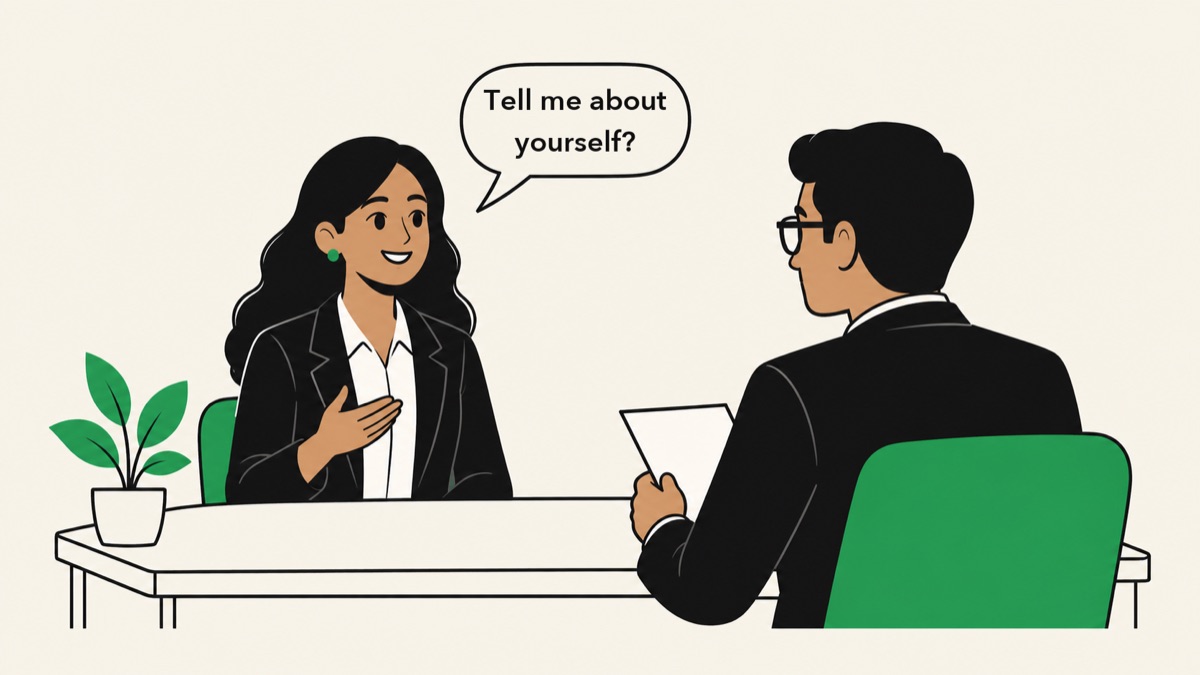
Almost every interview starts with the same line: "So, tell me about yourself." It sounds friendly and easy. It is also the question where a lot of people ramble for four minutes, recite their resume from class 10 onwards, and lose the interviewer before the real questions begin.
Quick answer: Answer "tell me about yourself" in 60 to 90 seconds using present, past, future. Say what you do now, one or two past experiences that fit this job, and why this role is your next step. Skip your school history and personal details.
The good news is that this is the one question you can fully prepare. You know it is coming, so walk in with an answer you have already said out loud a dozen times.
What the interviewer is really asking
They are not asking for your life story. They want a short pitch that answers three things: who you are professionally, what you have done that matters for this job, and why you are sitting in this chair today.
A good answer runs about 60 to 90 seconds. That is roughly 150 to 200 words spoken at a normal pace. If you go past two minutes, you are giving them the full resume they already have in front of them.
The present, past, future structure
The easiest structure to remember goes like this:
- Present: what you do right now, in one or two sentences.
- Past: one or two experiences that led you here and relate to this role.
- Future: why this job, at this company, is the logical next step.
That order works because it starts with the most relevant thing (what you do now) and ends by pointing at the job you are interviewing for. The interviewer's next question usually comes straight out of whatever you mention last, so you get to steer the conversation.
Sample answer for a fresher
I just finished my B.Tech in computer science from a college in Pune, and for the last six months I have been interning as a backend developer at a small logistics startup. There I built two internal APIs in Node.js and learned how much I enjoy working on things real users depend on. Before that, my final year project was a bus tracking app for our college, which about 300 students ended up using. I am applying here because your team works on large scale systems, and that is exactly the kind of problem I want to spend the next few years on.
Notice what is missing. No school marks, no hobbies list, no "I am a hard working and passionate individual." Every sentence carries a fact the interviewer can ask about.
If you have no internship, use your strongest project, a hackathon, a college society role where you organised something, or even a part time job. Anything where you did real work counts.
Sample answer for an experienced person switching jobs
I am a data analyst with about four years of experience, currently at a retail company where I own the weekly sales reporting for around 200 stores. Most of my work is SQL and Power BI, and last year I rebuilt our inventory dashboard, which cut the time managers spent on stock checks from a full day to about an hour. Before this I spent a year in a consulting firm doing Excel heavy analysis for clients. I am looking for a role where analysis feeds directly into product decisions, which is why this position on your growth team caught my eye.
With experience, the temptation is to list every job. Don't. Pick the one or two things that match the job description and let the resume cover the rest.
Sample answer for a career changer
For the last five years I have been a school teacher, teaching maths to classes 8 to 10. About two years ago I started building small tools to track my students' test scores, which got me into spreadsheets and then Python. I have since finished an online data analytics course and built three portfolio projects, including one that analyses board exam results by district. I am applying for this junior analyst role because I want to do full time the part of my old job I enjoyed most, which is finding patterns in numbers and explaining them to people who are not technical.
Career changers should not apologise for the switch. Frame your old career as the reason you are good at the new one. A teacher explains things clearly. A salesperson understands customers. Say that plainly.
Mistakes that cost people the first impression
- Starting with where you were born or your school.
- Reading your resume line by line.
- Using adjectives about yourself ("dynamic", "passionate", "go-getter") instead of facts.
- Talking about salary, notice period or why you hate your current boss.
- Ending with "so yeah, that's it" instead of a clear link to the role.
How to practise it
Write your answer down, then cut it by a third. Read it aloud with a timer. Record yourself on your phone and listen back once. It is painful, and it works, because you will hear every "basically" and "actually" you did not know you said.
Then change the last line for each company. The present and past parts stay mostly the same. The future part should mention something specific about the team or product you are interviewing with.
If you tend to freeze in the first minute of a call, SilentlyAI can help. It listens along on your interview call and shows a suggested answer on your screen when you ask for one, so a blank moment does not turn into a long silence.
Frequently asked questions
How long should my answer to "tell me about yourself" be?
Aim for 60 to 90 seconds, which is about 150 to 200 spoken words. Anything past two minutes starts repeating your resume.
Should I mention my hobbies or family?
Usually no. Mention a hobby only if it connects to the job, such as a design portfolio for a UI role or competitive programming for a developer role.
How do freshers answer "tell me about yourself" with no experience?
Use your degree, your strongest project or internship, and one achievement with a number, then say why this role fits what you want to learn next.
Is "tell me about yourself" the same as "walk me through your resume"?
They are close. "Walk me through your resume" invites a little more detail on each role, but the same present, past, future order still works.