Interview Anxiety: What to Do When Your Mind Goes Blank
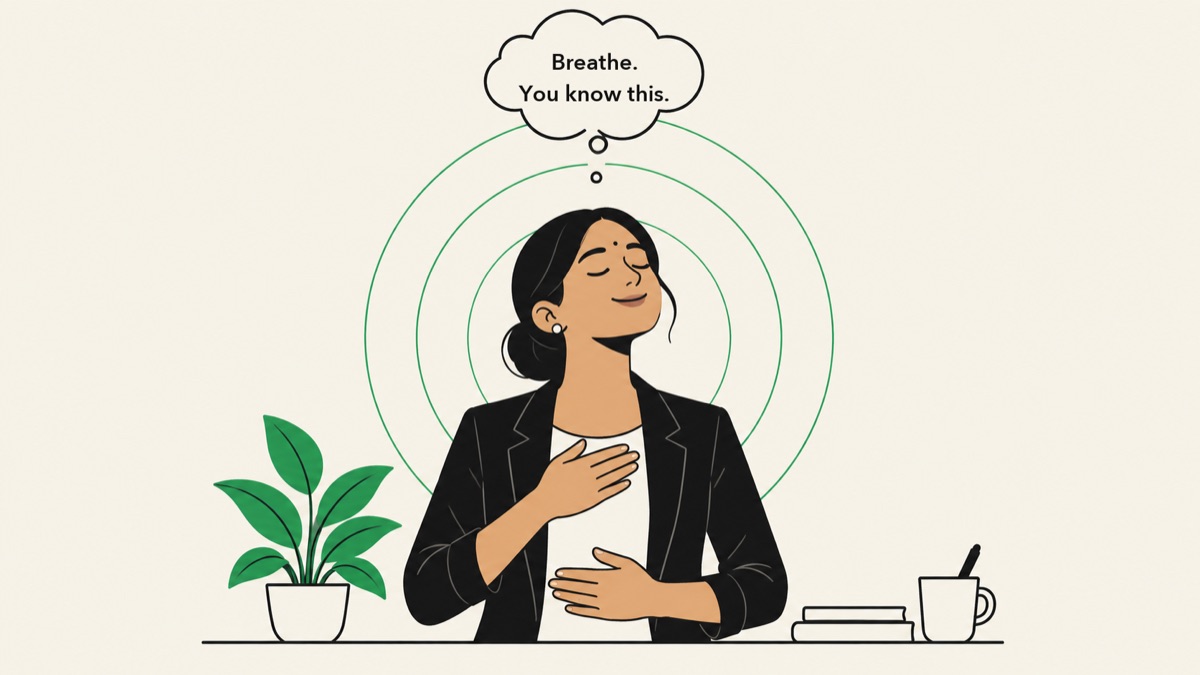
You prepared. You knew the answers last night. Then the interviewer asks something simple and your mind is completely empty. Five seconds of silence feels like a minute. You say something vague, and the rest of the interview gets harder because now you're also thinking about that moment.
This happens to almost everyone at some point, including experienced people. It isn't a sign you're unprepared or not good enough for the job. It's a stress response, and there are practical ways to handle it.
Quick answer: When your mind goes blank in an interview, pause, take one slow breath, and say a bridging phrase like "Let me take a second to think about that." Repeat the question in your own words, start with any part you do know, and build from there. Before the interview, practise answers out loud so they're easier to recall under stress.
Why it happens
When you're anxious, your body goes into a mild fight or flight state. That's useful for running from danger and not useful for recalling what a hash map is. Stress hormones make it harder to pull information out of memory, especially things you learned recently or only read once.
That's why saying answers aloud during practice helps so much. Things you've spoken many times are easier to retrieve under stress than things you've only read.
What to do in the moment
1. Pause and breathe
A slow breath out takes about four seconds, and it helps calm your body down. The interviewer won't notice a short pause as much as you think.
2. Use a bridging phrase
These buy time and sound thoughtful:
- "That's a good question. Let me think for a moment."
- "Let me make sure I understand what you're asking."
- "There are a few ways to approach this. Let me start with..."
3. Repeat the question in your own words
So you're asking how I'd handle a customer who wants a refund outside our policy?
This gives your brain a second look at the question and often brings the answer back.
4. Start with what you know
You don't need the whole answer before you start talking. Begin with the part you're sure of. In a technical question, that might be the brute force approach. In a behavioural question, it might be the situation, before you've picked the whole story. Once you start talking, the rest usually follows.
5. Be honest if it doesn't come back
I'm blanking on the exact term, but the idea is that we cache the result so we don't compute it again.
Interviewers respect honesty far more than bluffing. Explaining the concept without the exact word is often enough.
What to do before the interview
Practise out loud
Reading your notes isn't enough. Say your answers aloud, ideally to another person. Our guide to the STAR method shows how to prepare stories you can recall easily.
Do a warm-up
Before the interview, spend ten minutes talking. Call a friend, answer two practice questions aloud, or read something aloud. Starting cold makes the first few answers harder.
Keep a small notes sheet
For online interviews, a short sheet with your key stories and numbers (as keywords, not full sentences) is reassuring even if you never look at it.
Sleep and eat
This sounds obvious, but many people stay up cramming the night before. A tired brain blanks more easily. Eat something light an hour before.
Reframe the nerves
Some anxiety helps you focus. Research on "anxiety reappraisal" suggests that telling yourself "I'm excited" can work better than "calm down". It's worth trying.
After a bad moment
One blank moment rarely decides an interview. What matters more is how you recover. Don't keep apologising. Answer the next question well. If you think of the answer later, it's fine to come back to it:
Earlier you asked about indexing. I didn't answer it well, and I'd like to add something.
That shows composure, which interviewers value.
If anxiety is severe
If interview anxiety is causing panic attacks or stopping you from applying at all, it's worth talking to a counsellor or doctor. That's a health issue, not a weakness.
A safety net for blank moments
Some people feel much calmer knowing there's a backup. SilentlyAI listens along on your interview call and, when you ask, shows a suggested answer on your screen. Often just seeing the first line is enough to bring your own answer back.
Frequently asked questions
Is it normal for your mind to go blank in an interview?
Yes. It's a common stress response that happens even to experienced and well-prepared candidates.
How do I stop my mind from going blank?
Practise answers out loud, warm up before the call, sleep well, and learn a few bridging phrases so a pause doesn't turn into panic.
What should I say if I don't know the answer?
Be honest, explain what you do know or how you'd find the answer, and connect it to something similar you've done.
Will one bad answer ruin the interview?
Rarely. Interviewers look at the whole conversation. A calm recovery after a bad moment can even leave a good impression.